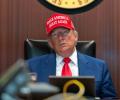
United States President Donald Trump said a 'very big' trade deal is on cards with India, hinting at significant progress in the negotiation process of a long-awaited bilateral trade agreement between the two countries.

'It is good to have the H1-B visa option but if tomorrow things happen to change, it is not the end of the world situation.'
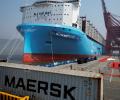
Government representatives told a parliamentary panel that the US has not officially conveyed to India that it should cut tariffs by April 2.
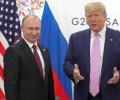
Trump reiterated that he is not negotiating on behalf of Ukraine, but rather aiming to bring the parties to the negotiating table.
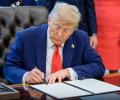
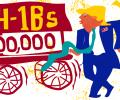
The Donald Trump administration has clarified that the new $100,000 fee for H-1B visas does not apply to current visa holders and is a one-time payment only for new petitions.
'As one of many immigrants at Nvidia, I know the opportunities we've found in America have profoundly shaped our lives.'
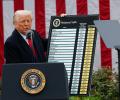
Amid the tumbling stock market in the United States, following the White House clarification of tariffs on China to be at least 145 per cent and an earlier announcement of a 90-day pause on tariffs for over 75 countries, President Donald Trump addressed the challenges associated with his tariff policy, stating that there would be 'transition problems'.
The White House has said India imposes a 100% tariff on American agricultural products and the high levies charged by other countries make it "virtually impossible" for US products to be exported to those nations. President Donald Trump has repeatedly criticised the high tariffs charged by India and other countries on American goods. He plans to roll out a set of reciprocal tariffs on April 2, which he says will be "Liberation Day" for the US.
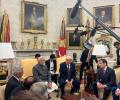
Who accompanied Prime Minister Narendra D Modi to his Thursday meeting with US President Donald J Trump in the Oval Office, and who did POTUS bring along?
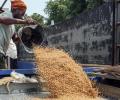
'What the US appears to be doing is to force India to be "the buyer of last resort", on whom their products can be dumped, 1.4 billion people have to eat something, so why not eat American corn?' 'What is exercising the Trump lot is the fact that most of the farms are in solidly Republican Midwestern states: Illinois, Indiana, Kansas, Michigan, Minnesota, Missouri, Nebraska, North Dakota, Ohio, South Dakota, Wisconsin,' points out Rajeev Srinivasan.
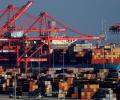
Senior officials of India and the US will begin three-day talks on the proposed bilateral trade agreement in New Delhi on Wednesday amid threats of reciprocal tariffs from the Trump-administration, an official said. To formally start the negotiations on the pact, Assistant US Trade Representative for South and Central Asia Brendan Lynch, along with a team of officials, is in New Delhi.
Very sensitive items -- such as apples, which carry political weight and are closely tied to farmer interests in states like Himachal Pradesh and Uttarakhand -- may face restricted concessions.

The Trump administration has announced a massive increase in H-1B visa fees, imposing a $100,000 annual charge that will fundamentally alter how American companies hire skilled foreign workers, particularly impacting Indian IT professionals who comprise the largest group of beneficiaries.
Trump on February 1 had announced tariffs on major US trading partners Canada, Mexico and China. He imposed a 25 per cent tariff on Canadian and Mexican imports and a 10 per cent on goods from China.
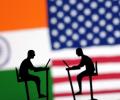
India and the US are likely to agree on an interim trade agreement before July 8 with New Delhi pushing for full exemption from the 26 per cent reciprocal tariff on domestic goods, an official said. The US on April 2 imposed an additional 26 per cent reciprocal tariff on Indian goods but suspended it for 90 days till July 9.
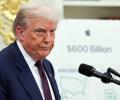
United States President Donald Trump has said India is 'very close' to China in terms of its purchases of Russian oil and will pay tariffs of 50 per cent as he indicated that 'you are going to see so much secondary sanctions'.

He went on to say that even though this has not been discussed, he is going to 'increase trade substantially with both of these great Nations.'
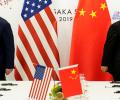
The call lasted approximately one and a half hours, and resulted in a very positive conclusion for both countries.
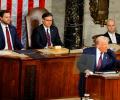
I'...additional concessions, such as opening government procurement, reducing agricultural subsidies, weakening patent protections, and allowing unrestricted data flows -- demands India has resisted for decades.'
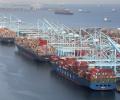
India and the US have decided to hold sector-specific talks in the coming weeks to finalise the structure of the proposed bilateral trade agreement (BTA), the government said on Saturday. The engagement between the two countries came in the backdrop of the USA's threat to impose reciprocal tariffs on its key trading partners, including India, on April 2.
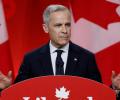
In a dramatic shift in Canada's foreign policy, Prime Minister Mark Carney on Thursday declared that the long-standing economic and security relationship between Canada and the United States has ended, responding to US President Donald Trump's announcement of new auto tariffs that could severely impact Canada's economy, Politico reported.
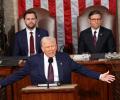
Trump has made it clear to Prime Minister Modi that India will not be spared from Washington's reciprocal tariffs and emphasised that "nobody can argue with me" on tariff structure.

India and the United States will finalize the contours, schedule of negotiations, and terms of reference for a proposed bilateral trade agreement (BTA) during a three-day meeting beginning Tuesday. The agreement is expected to be finalized in two tranches, with the first phase focusing on goods trade. The US team, led by Assistant US Trade Representative for South and Central Asia Brendan Lynch, will be in India from March 25-29 to discuss the agreement. Both countries are aiming to conclude the first phase of the agreement by fall 2025.
